Hours
Mon: Closed
Tues: 9:00AM-5:00PM
Wed: 7:00AM-5:00PM
Thurs: 9:00AM-5:00PM
Fri: 8:00AM-4:00PM
Sat: 8:00AM-3:00PM


If you’re missing a tooth, or you’ve been told a tooth can’t be saved, a dental implant is the closest thing to getting the real tooth back. It replaces the root as well as the crown, so it looks, feels, and works like a natural tooth. But an implant isn’t placed in a single visit, and it helps to know what you’re signing up for before you start.
The short answer: The dental implant process usually runs in five stages: an exam and planning visit, any extraction or bone graft needed first, placing the implant, a healing period of about three to six months while it bonds with the bone, and fitting your permanent crown. Most of that time is spent healing, not in the dental chair.
This guide walks through each step, how long it takes, whether it hurts, and how to look after your implant, so you know what to expect from your first exam to your final crown.
A dental implant has three parts. The implant post is a small, screw-shaped piece of medical-grade titanium that is placed in your jaw, where the bone grows around it and holds it in place. The abutment is a small connector that sits on top of the post. The crown is the tooth you see, custom-made to match the shape and shade of the teeth beside it.
Because the post bonds with the bone, an implant doesn’t lean on the neighboring teeth for support, and it keeps the jawbone in that spot stimulated the way a natural root does. That’s also why the process takes time: the bone needs months to grow around the post before it can carry a crown.

Every implant starts with a careful look at the site. Planning usually includes:
Most healthy adults who are missing a tooth are candidates. The main requirements are healthy gums, enough jawbone to hold the implant, and good general health for healing.
Not everyone needs this step, but it’s common. If the tooth is still in place and can’t be saved, it’s removed first. Our guide When Is a Tooth Extraction Necessary? explains how dentists make that call.
If the bone has thinned since the tooth was lost, a bone graft can rebuild it. A graft can also be placed into the socket at the same appointment as an extraction, which limits how much the ridge shrinks and keeps the future implant straightforward. Active gum disease is treated before an implant goes in, because healthy gums are part of what keeps an implant stable.
Each of these adds its own healing time before the implant can be placed. Grafted bone, in particular, takes months rather than weeks to mature.
On placement day, the area is fully numbed with local anesthetic. A small opening is made in the gum, the implant post is placed in the jawbone at the planned position and angle, and the gum is closed with a few stitches. Most patients describe pressure rather than pain, and you go home the same day.
If the implant replaces a tooth people can see when you smile, ask about a temporary tooth for the healing period. Your dentist may offer a temporary crown, bridge, or removable partial denture so you can eat and speak normally while you wait.
This is the longest part of the process, and most of it happens without you noticing. The gum over the site usually heals in about one to two weeks. Underneath, the bone grows around the implant over roughly three to six months and locks it in place. This is called osseointegration, and as the American Dental Association explains, it’s what makes an implant so strong. During healing:
Once the implant is solid, the abutment is attached and your permanent crown is made. A digital scan or impression captures the site, and the crown is shaped and shaded to blend in with the teeth beside it. Most implant crowns are made from porcelain or zirconia. The crown is then secured to the implant, and your new tooth is ready to use.
From then on, an implant is cleaned and checked much like your natural teeth. With good care the implant post can last for decades, and it’s the crown on top that takes the wear of chewing and may need replacing years down the line.
For most people, it takes several months from placing the implant to fitting the final crown, and longer if an extraction or graft is needed first. Here’s how the time usually breaks down:
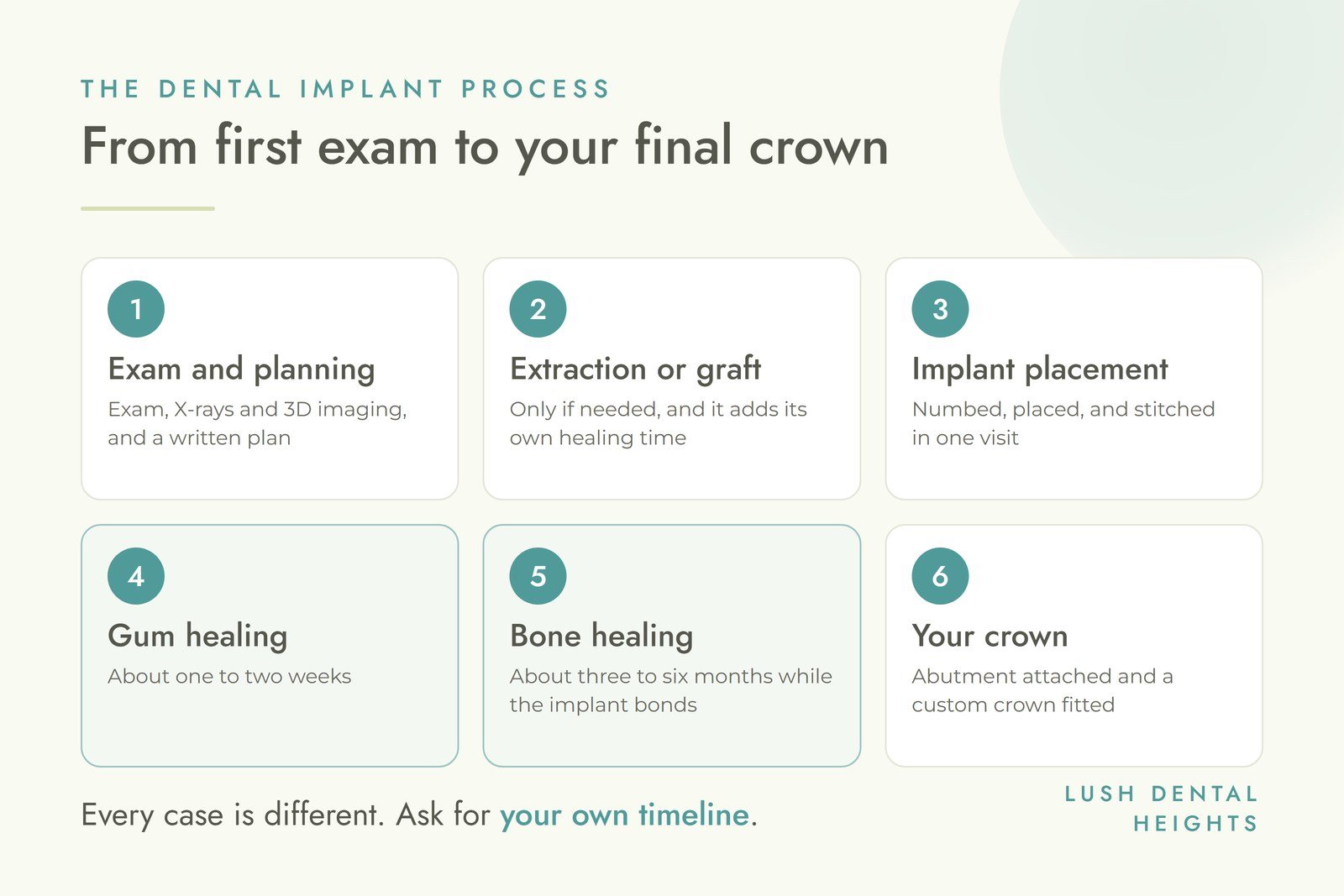
Your exact timeline depends on the site, your bone, and any work needed first, so ask for it at your consultation.
Less than most people expect. The placement is done under local anesthetic, so the area is fully numb, and patients usually feel pressure rather than pain. If you feel anxious, tell your dental team before you start, so they can talk you through each step and check in as they go.
Afterward, some soreness, swelling, and minor bleeding are normal for a few days. Over-the-counter pain relief, a cold compress, and soft foods usually manage it well, and most people are back to their normal routine within a day or two.
Call your dentist if pain gets worse instead of better after a few days, if swelling keeps increasing, or if bleeding won’t stop with gentle pressure.
An implant can’t get a cavity, but the gum and bone around it still need daily care. Plaque left around an implant can lead to an infection called peri-implantitis, which can cause the bone around it to shrink. To keep your implant healthy:
An implant is one of several ways to replace a missing tooth. A dental bridge is fixed in place and quicker to complete, but the teeth on either side are reshaped to carry it. A removable partial denture usually costs the least, but it rests on the gum and doesn’t stop the bone underneath from shrinking. An implant takes the longest, but it stands on its own, leaves the neighboring teeth untouched, and helps preserve the bone. The right choice depends on the tooth, your bone, your budget, and how long you want the result to last.
If you’re missing most or all of your teeth, our guide What Are Full Mouth Dental Implants, and Who Are They For? covers the options for a full arch.
Your fee depends on whether you need an extraction or bone graft first, how many implants you need, the crown material, and your insurance. Many dental plans don’t cover the implant itself but may contribute toward the extraction or the crown. For a full breakdown, see How Much Does a Dental Implant Cost in Houston?

At Lush Dental Heights on North Main Street in the Heights, Dr. Pasha Noorian, DMD, provides dental implants for patients from across Houston, from a single tooth to several. He examines the site, checks that your gums and bone are ready, and builds any extraction, gum treatment, or bone graft into your plan, so you leave your consultation knowing the stages, the timeline, and the cost of each step. Your custom crown is either milled in our office or made by our partner lab to match the teeth beside it.
We accept most insurance plans, including Aetna, Cigna, Delta Dental, Guardian, MetLife, and UnitedHealthcare, and financing is available through Cherry, CareCredit, Sunbit, and HFD, pending approval.
Call (713) 487-9618 or request an appointment online. We’re at 5307 N Main St, Suite 200, Houston, TX 77009, and we welcome patients from the Greater Heights, Garden Oaks, Woodland Heights, Rice Military, and across Houston.
Most people go from implant placement to final crown in about three to six months, which is the time the implant needs to bond with the bone. An extraction or bone graft beforehand adds its own healing time. Your dentist can map out your own timeline at your consultation.
Usually several, spread over a few months: a consultation and planning visit, any extraction or graft, the placement itself, one or more check-ups while you heal, and the visits to scan for and fit your crown.
Not necessarily. Depending on where the tooth is, your dentist may offer a temporary crown, bridge, or removable partial denture so you can eat and smile normally while the implant bonds with the bone. Ask about this before your placement visit.
Not while the gum disease is active. It’s treated first, because inflamed gums and bone loss can stop an implant from healing well. Once your gums are healthy, an implant may be an option, and a bone graft can rebuild bone that has been lost.
Often, yes, but smoking slows healing and raises the risk that the implant won’t bond with the bone. Be open about it at your consultation. Your dentist may suggest stopping, at least around the time of surgery and healing, to give the implant every chance to heal well.
Age alone usually isn’t the issue. The American Dental Association notes that your health is more of a factor than your age. What matters most is that you’re healthy enough to heal well, with healthy gums and enough bone to hold the implant.

© Lush Dental Heights
Website by Wonderist Agency | Privacy Policy
